Your dermatologist will also discuss the safest and most appropriate treatment options should you choose to have your skin lesions removed. Some treatments are considered cosmetic and are not covered by OHIP, while others may be covered by OHIP or private (work) insurance, depending on the specific condition and treatment. For the best possible results, it is important to have your skin lesions assessed and treated by a qualified skin specialist with extensive training and experience.

Many different growths occur normally on the skin. Mole Removal should be decided by a medical doctor, a skin care specialist and expert, to ensure a correct diagnosis. A Dermatologist is a medical doctor who has undergone additional extensive training in the study of diseases of the skin (5 years), and has successfully passed the Dermatology Specialty examinations of the Royal College of Physicians & Surgeons of Canada. Our Dermatologists at the Toronto Dermatology Centre will assess your skin growths and discuss with you whether they are safe or potentially dangerous.
Moles
Moles (nevi) are common skin growths that are usually brown or flesh-coloured and may be flat or raised. If you choose to have a mole removed, the appropriate treatment method will depend on its size, location, and characteristics.
It is important to have any mole that looks unusual or changes over time assessed by a qualified medical professional. Warning signs may include asymmetry, irregular or uneven borders, a very dark or changing colour, multiple colours within the same mole, or a diameter greater than 6 mm. These changes can sometimes be associated with skin cancer, including melanoma, and may require further examination and/or testing.
Do not attempt to remove a mole yourself or have it removed at a salon or spa. Improper removal can result in scarring, disfigurement, infection, or may interfere with the proper assessment of a potentially concerning lesion. For safe and appropriate mole removal, seek treatment from a qualified medical professional experienced in the assessment and removal of skin lesions.
Skin Tags
Skin tags are benign, fleshy skin growths that are brown or flesh-coloured and occur in warm, moist areas where clothing usually rubs, such as around the neck, underarms, breasts and groin areas; occasionally they are also found around the eyes.
Skin tags become increasingly common with age, are more common if there is a family history of them, and are more common with weight gain, diabetes and pregnancy. Skin tags are often numerous and catch on clothing or jewelry and can be removed easily and safely by your dermatologist using a variety of techniques (e.g. laser, electrosurgery, or excision depending on size & location & skin type). Home or self- skin tag removal is not advised as we have observed scarring, infections, significant pain and generally poor results. For skin tag removal in Toronto, trust our experienced dermatologists.

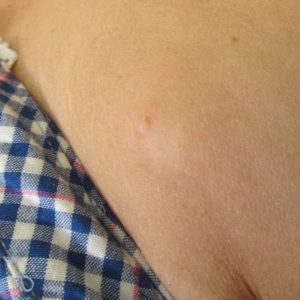
Before & immediately after removal of large skin tag
Seborrheic Keratoses
Seborrheic Keratoses (SKs) are brown or black raised spots or wart-like growths look like they were stuck on the skin surface. There may be just one growth or many which occur in clusters.
Seborrheic Keratoses are not cancerous and not contagious. They may be unsightly, and many patients request their removal. Creams, ointments, or other medication can neither treat nor prevent seborrheic keratoses.
Seborrheic keratoses can be safely and easily removed by a dermatologist through such techniques as laser, cryosurgery, curettage, or electrosurgery. Depending on the technique and size and thickness of the lesion, 1-4 treatment sessions with your dermatologist are typically required to clear these lesions, though new lesions will continue to appear with age and as a result of genetics. Sun is not a factor in the development of seborrheic keratoses.

Before & after removal of seborrheic keratosis
“Age Spots” or “Liver Spots”
These flat, brown areas are called lentigines. In fact liver spots have nothing to do with the liver (though they are the colour of our liver) – they are caused by the sun as well as the aging process, and usually appear on the face, hands, back and feet.
Age spots are generally harmless. They may look like melanoma and therefore may require evaluation. Commercial “fade” creams will not make lentigines disappear. To remove age spots or brown spots, trust our experienced Toronto dermatologists.
Liquid nitrogen cryotherapy and laser therapies can help fade these spots. 1-4 treatment sessions by your dermatologist are typically required to clear age spots, though new lesions will continue to appear with age over time.
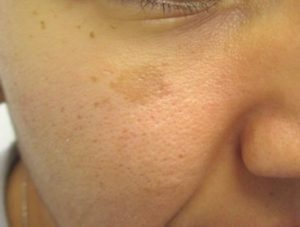

Before & after removal of age spots
Cherry Angiomas
Cherry Angiomas are harmless, small, bright red raised bumps created by dilated blood vessels. They occur in more than 85 percent of middle-aged and elderly people, usually on the trunk.
Electrocautery, laser (e.g. Excel-V), or other surgical therapies safely and effectively remove cherry angiomas. 1-2 treatment sessions by your dermatologist are often needed to clear these lesions, though new lesions will continue to appear with age.

Broken Capillaries or Telangiectasia
These dilated facial blood vessels may be related to sun damage. They respond to the same treatments as other broken blood vessels (angiomas).
2-6 electrocautery or laser treatment (e.g. Excel-V) sessions with your dermatologist are typically required to clear these lesions. Trust our experienced Toronto dermatologists for a safe and effective treatment for your broken blood vessels.
For the assessment and removal of any skin lesion, trust the true skin experts – dermatologists. Our Toronto dermatologists are happy to assess any skin lesion and provide education and counselling (e.g. is the lesion benign or malignant? might it go away on its own? the cause and prevention of future lesions), as well as a variety of treatment options to work within your budget. Treatment of some skin lesions may be covered by the provincial OHIP plan or by private (e.g. work) insurance.
To read more about BBL/photorejuvenation – Click Here
If you have any benign lesions, a referral from a doctor is not required for assessment. Contact us today.
Toronto Dermatology Centre is located in Toronto, Ontario, and serves men and women in North York, Vaughan, Richmond Hill, York, Aurora, Thornhill, Mississauga, Scarborough, Brampton, Etobicoke, Pickering, Peterborough, Guelph, Kitchener, Oakville, Barrie and all of Greater Toronto (GTA).
Thinking of visiting Toronto’s premier skin clinic soon?
Fill out the inquiry form below and let us know your area of interest.
Call us today @ 416.633.0001
For all medical bookings & inquiries
Call us today @ 416.551.3138
For all cosmetic bookings & inquiries